How to store potatoes and onions while protecting quality
Potatoes and onions need different humidity regimes. A practical overview of grading, curing, ventilation, condensation and ongoing checks — and why one uncontrolled store will not serve both crops.
Author: AGRICO Bohemia
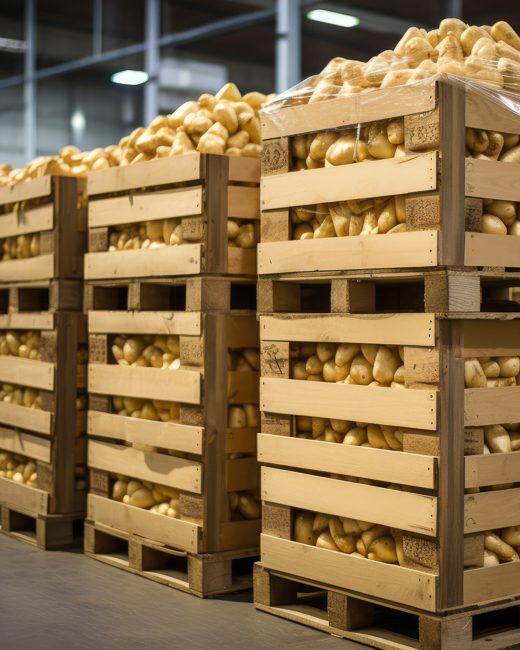
Most losses on potatoes and onions do not happen in the field — they happen after harvest. Produce that arrived in good condition can deteriorate within weeks through moisture, condensation or the wrong light. The good news is that the principles of storage are fairly simple. The usual problem is that both crops end up in the same uncontrolled space.
Potatoes and onions do not have the same requirements
This is the single most important sentence in this article. Potatoes need relatively high humidity so they do not lose weight and shrivel. Onions need a distinctly drier environment; in damp conditions they start to root, mould and go soft in the neck.
Putting both crops in one garage, one cellar or one shed without controlled ventilation therefore guarantees that at least one of them sits in the wrong conditions. At commercial scale this is solved with separate stores, or at minimum separate sections with their own ventilation regime.
It starts with grading
Only sound, undamaged produce belongs in a store. A single rotting tuber or one infected onion can start a local hotspot that spreads in an enclosed space.
- Remove mechanically damaged, cut and bruised units.
- Reject anything showing rot or mould.
- Remove soil and haulm residues, which hold moisture.
- Do not mix batches of markedly different quality or history in one crate.
Curing and drying before storage
After harvest, potatoes need a short phase in which minor skin injuries heal over. It runs at a higher temperature and high humidity, and it is the cheapest available protection against rots for the whole of the following storage period.
Onions, by contrast, need drying down after harvest — the goal is a dry, closed neck and dry outer scales. As long as the neck stays moist, it is an open door for pathogens.
Only after these phases is the store gradually cooled towards its target temperature. Rapid chilling of warm produce is one of the most common causes of condensation.
Darkness for potatoes
Potatoes must be kept dark. In light they green, form chlorophyll and increase their glycoalkaloid content, which spoils the product and changes its taste. That applies to short exposure on a loading bay or a retail shelf too.
Onions tolerate light considerably better, though permanent lighting is not desirable for them either.
Ventilation and condensation
The purpose of ventilation is not only cooling but removing moisture and metabolic heat. Without airflow, warm and damp spots form inside the bulk where nobody can see them.
What to watch:
- Even airflow — air has to pass through the whole layer, not merely around it.
- Temperature differentials — whenever produce is colder than the air, water condenses on it. Condensation on tubers or bulbs is the precursor of rot.
- Gradual changes — move temperature and humidity slowly, never in steps.
- Clearance around pallets and crates — a tightly packed heap cannot be ventilated.
Temperature is not one universal number
It is tempting to look for a single "correct" storage temperature. In practice none exists. The optimum differs by crop, variety, intended length of storage and above all by end use. Potatoes for quick despatch, potatoes for long storage and potatoes for processing are all stored differently. That is why the storage regime should follow the specific batch and its destination, not one figure copied from a table.
Ongoing checks
A store is not a set-and-forget system. The basic routine:
- Measure temperature and humidity regularly, ideally at several points.
- Check whether condensate is forming on walls, ceilings or packaging.
- Use both nose and eyes to find developing hotspots — rot can be smelled before it can be seen.
- Monitor sprouting and rooting and adjust the regime or despatch accordingly.
- Keep simple records. Without them there is no way to work out afterwards what went wrong.
Handling and transport
Most damage happens during transfers. Drops from height, hard impacts on conveyors and overfilled crates cause bruising that only becomes visible weeks later.
- Minimise drop heights on conveyors and when filling crates.
- Do not move produce chilled below the dew point of its destination without tempering.
- Protect loads from both frost and direct sun.
- Keep the chain tight — the shorter the time between store, packhouse and customer, the better the quality that reaches the shelf.
Frequently asked questions
Can I store potatoes and onions in one room?
Short term and in small volumes, yes, but it is not ideal. Their differing humidity requirements mean one crop will always sit in compromise conditions.
Why did my stored potatoes get wet with no rain?
Almost always condensation — warm humid air met colder produce. The fix is gradual temperature changes and better airflow.
Why do onions go soft in the neck?
Usually because they were not dried down sufficiently, or the environment is too humid.
How do I spot a developing problem in time?
By smell, by a warm spot in the bulk and by moisture on packaging surfaces. These three signals precede visible rot.
Is measuring worth the investment?
Yes. Simple temperature and humidity monitoring is the cheapest loss prevention available.
How we handle it
For us storage, grading and packing are not separate steps but one connected process with quality control. You will find details on the Packhouse and quality page and the range on the Products page.
Need supplies with traceable quality? Send us an enquiry.
Sources
The general technical principles draw on public materials:
- Potato Research Institute Havlíčkův Brod — storage
- AHDB Potatoes — storage systems
- University of Minnesota Extension — postharvest handling of fruit and vegetable crops
- #skladování
- #brambory
- #cibule
- #kvalita
Need a concrete offer?
Share the commodity, packaging, weekly volume, delivery location and timing — we will come back with a proposal.
The message is sent securely through the form to info@agricobohemia.cz — no email client will open.